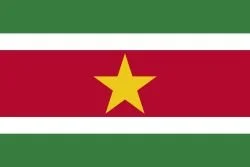
"Justitia Pietas Fides (Justice, Faith and Loyalty)"
Suriname
General: Governed by the 1975 State Ordinance on Nationality and Residence ("Wet op de Surinaamse Nationaliteit en het Ingezetenschap"), as amended (last major consolidations through the 1980s–2010s), and the Constitution (independent of the Netherlands since November 25, 1975).
By Birth: Birth in Suriname alone does not automatically confer citizenship unless a parent is Surinamese, or the child would otherwise be stateless/of unknown parentage (foundlings), or in narrower cases involving habitually resident stateless/undocumented parents. (A historic exception applied automatically to persons born in and domiciled in Suriname at the time of independence in 1975.)
By Descent: The dominant route — a child acquires Surinamese nationality at birth if at least one parent holds Surinamese nationality, regardless of the child's place of birth.
By Registration: A foreign woman who marries a Surinamese citizen may apply for citizenship through registration/an "option" procedure; children adopted (domestically or through recognized international adoption) by Surinamese nationals acquire nationality automatically upon finalization.
By Naturalization: There are three recognized categories — general naturalization, naturalization "in the state interest" (by presidential/ministerial decree), and "option"-based naturalization. Standard general naturalization requires at least 5 years of continuous legal residence, demonstrated integration (including Dutch-language ability, as Dutch is the official language), good character, and — critically — normally requires renunciation of the applicant's prior nationality.
Dual Citizenship: Generally not recognized/permitted for adults acquiring citizenship as adults — Suriname requires renunciation of prior nationality upon naturalization in most cases, and dual nationality is explicitly barred for holders of public office (government, military, judiciary) under Article 178 of the Constitution and related statutes. Limited transitional or case-specific exceptions exist (e.g., some children born with dual nationality by birth/descent may hold both until a choice is required, and enforcement against Surinamese-Dutch dual nationals in the large diaspora in the Netherlands has in practice been inconsistent due to limited data-sharing).
Loss of Citizenship – Voluntary: A Surinamese citizen may voluntarily renounce citizenship, generally required as part of acquiring a foreign nationality through naturalization abroad, given the general prohibition on dual nationality.
Loss of Citizenship – Involuntary: Nationality can be lost through voluntary acquisition of a foreign nationality (given the no-dual-citizenship default for adults), and naturalized citizenship can be revoked for fraud or misrepresentation in the application.
Serving The Countries of CARICOM: Antigua and Barbuda, The Bahamas, Barbados, Belize, The Commonwealth of Dominica, Grenada, Guyana, Haiti, Jamaica, Montserrat, Saint Lucia, Saint Kitts and Nevis, Saint Vincent & Grenadines, and Trinidad and Tobago.